Seattle to Oshkosh: Preparation
Posted Saturday July 13, 2019
Before we begin, a bit of background.
I started building a biplane a few years ago. This is a long, complicated project, which I expect to take 10-20 years. I'm about a year and a half in, and not moving as fast as I thought I would (thus the 20 year end of the range). One of the things that's true about a project of this scale is that seeing other examples and talking to other builders is a very good idea.
To that end, I belong to a number of online gathering places (such as the Biplane Forum), and I attend local airplane nerd gatherings to talk with other folks who are taking the same journey. But the ultimate gathering for airplane nerds is EAA AirVenture (also and more commonly known as Oshkosh), which is effectively the biggest fly-in/aviation conference in the world. It's something of a Mecca for many aviators, whether they're building their own plane or not, with tens of thousands of aircraft attending, hundreds of thousands of people, and more things to see than any one person can experience in a mere week.
I figured I should, one of these days, attend Oshkosh, but I wasn't putting a huge value on it. I had committments at home that made it impractical, so it always seemed like one of those things to do later.
Then, at the end of last year, my life suddenly changed, and it became very nearly practical. I requested three weeks off from work, got them, and started planning things out.
The Plane
I would fly in my little plane, Norbert, a 1956 Champion 7EC.
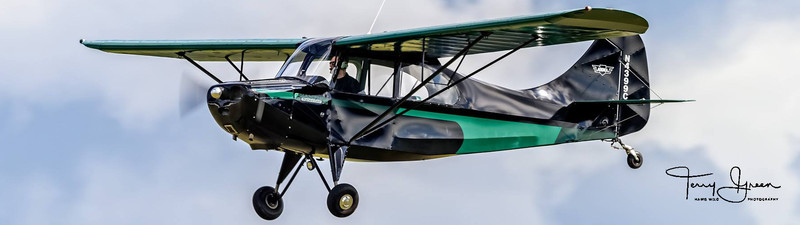
Norbert is many things, but "fast" is not one of them. Its cruising speed is about 85 MPH in typical conditions. It can cruise up to about 11,000 feet, but getting from 9,000 to 11,000 feet would probably take as long as it took to get from the ground to 9,000. I found on a previous trip that cruising over 9500 feet is feasible but not great.
It carries, according to its placards, 26 gallons of fuel. According to my measurements, the most I've ever successfully filled is about 24 gallons before the tank starts spitting and overflowing. It burns about 5.5 gallons per hour in cruise, which means it's got a bit over 4 hours of endurance between fuel stops. I always leave myself a fair margin for safety, so 3 hours is about my maximum hop length. If the air isn't actively opposing me, that's a bit under 250 miles between fuel stops (climbing up to cruising altitutde is slow).
Norbert can legally carry 450 lbs of weight, of which I take up 220, and full tanks take up 144. That leaves 86 lbs of carrying capacity. Enough for some baggage, but not enough to carry another person. That means I'll be flying this trip solo. I don't know anyone else who flies a plane as slow as mine, so I won't be with a group en route either.
Norbert is equipped for Day VFR operations, which means I can't fly if the sun is below the horizon, and I can't fly through clouds. Fortunately, it does have ADS-B Out, which means that you can follow my flight on Flightradar24 (or any other flight tracking service, search for N4399C). I have a tablet that shows other traffic in the area using ADS-B In. I'll be sending location updates via APRS as well, which has been more reliable than Flightradar24 on past trips.
The Trip
The great circle distance between Seattle and Oshkosh is 1637 miles, which would take me nineteen and a quarter hours, if I were able to fly the whole distance at 85 MPH. I definitely can't do that, so adding on an extra 20% as a best-guess for landing and taking off time, I'll put a bit over 23 hours on Norbert's hour-meter if I flew straight there. Even that is optimistic, since I'm unlikely to fly in a straight line, and will probably deviate from the great circle route pretty substantially in places.

Indeed, I'm much more likely to fly smack over I-90, at least as far as mid-Montana. This gives me a trail of humanity and airports and semi-safe landing areas that would reduce recovery to a mere tens-of-thousands-of-dollars operation compared to landing somewhere far from a road, possibly involving helicopters, in the case of a forced landing.
All this is to say that I'll probably be spending 25-30 hours getting from Seattle to Oshkosh. At about 6 hours of flying a day (leaving lots of room for weather to play its games), this makes the trip about 5 days.
Where Will You Stop?
One of the big questions everyone asks about this trip is, "Where will you sleep on the way?" The slightly giddy answer is, "I don't know." Because I can't actually plan for what weather will do at any given moment, I need to be quite flexible. To that end, I'm packing a tent and sleeping bag and tiny cooler so I can bring dinner with me if necessary. I'll sleep at the airport if I can, or get a taxi to a local motel if I can't. Many airports seem to have pilots' lounges where it's kosher to spend a night as you travel.
The same answer applies to "Where will you land?" I can't really know until the moment, since a headwind could very realistically slow me down to 65 MPH over the ground, and a tailwind could easily push me past 100 MPH. A thunderstorm could force me to backtrack an hour's worth of forward progress.
The country is dotted with many many small airports. For instance, in the Seattle area, there's SeaTac, of course, but there's also Boeing Field. Then there's Renton, and Paine in Everett, and Harvey in Snohomish, and Bremerton, and Arlington, and several on Whidby Island, to say nothing of Auburn, Puyallup, and on and on. Basically, if there are people anywhere nearby, there's probably an airport within about 50-100 miles. The end result is that the country is well served by a network of thousands of small airports where a pilot like myself can tank up, maybe get a bite to eat, and spend a night.
Preparing for the Trip
My preparations for the trip started in the latter half of 2018. I bought my tickets for the event itself. I found a dorm room at the University of Wisconsin at Oshkosh, and was later bumped up to an air-conditioned room thanks to some judicious placement on a wait-list. I hosted an informal seminar on hints for flying to Oshkosh. Then I kind of shelved it, since there wasn't a lot more I could do until I got closer.
In the meantime, I did spend some time thinking about what I would bring. The plane is not hugely capacious for baggage, but my previous flights to Los Angeles and Humboldt proved that I could take along a reasonable set of gear for a trip like this.
I figure I'm going to run into the following conditions:
- Mostly sunny
- Temperatures from 40° to 95° F
- Up to 80% humidity
- Thunderstorms with heavy rain
Packing for that kind of range means I'll have to carry a greater diversity of clothing than on previous trips, but otherwise this will be similar to the California flights.
In addition to the wider range of weather, I'll be away from home for much longer: the previous trips were a week or less, and this will be at least two and a half weeks, if not three. In that sense, I'm treating it much like I did my fairly epic motorcycle trip to Europe in 2013. That is to say, don't bring too much, and plan to familiarize self with self-service laundry facilities. This time I won't have to figure out how to translate "laundromat" into the local tongue, though, and I'll actually be able to use the genius of the internet to help me.
Surely You Planned Better Than Last Time, Right?
I did not. Well, that's not entirely true. But I could have done much better. Apparently I haven't yet learned to reserve the last half-week before a trip for myself, instead foolishly agreeing to put things on my schedule like filming for a project until midnight on the Friday before the nominal start date for the trip. It'll be a great film when it's done, but that was not a clever move on my part.
The result is that this Saturday before my nebulously-unplanned weather-will-dictate departure has been spent working on the stuff around the house that needs to get done before I can even get to the trip preparations. Add in the clean-up from a fairly voluminous toilet overflow this morning, and I'm feeling behind before I've even started. Fortunately, I did plan somewhat well, in that I have several days before I absolutely must leave. Thanks, past-Ian!
Part of what's odd about this trip, compared to previous travels I've engaged in, is that the schedule is in fact completely nebulous. I can check the weather now, but weather prediction more than about a day out is unreliable. I'm not used to this kind of ambiguity, and it's not something I'm naturally comfortable with. An interesting challenge.
Documenting the Trip
As part of this trip, I'll be writing up each day's experience (much like this entry), to be annotated with photos once I get back to a computer. I'll also be taking time-lapse video out the front window as I fly, which will be edited into daily flight shorts.
In some of my semi-related preparatory research for the trip, I came across the story of the first crossing of the Atlantic Ocean in a biplane, by Jack Alcock and Arthur Whitten Brown. What caught my eye about this was that they had a mascot, Lucky Jim, a toy cat. I thought this sounded like a fine idea, so I located a green dragon toy as my mascot (Norbert the plane is named after the baby dragon Hagrid hatches in the first Harry Potter story), who should be visible in all the time-lapse video, encouraging me on my trip.

This has all been an excuse to post this picture of Norbert the dragon
Text updates will be posted, most likely once per day, on the main page. Photos will have to wait, since my phone's camera is broken, and I'll be using an Old Man Camera that doesn't connect to the internet on its own.
Copyright © 2019 by Ian Johnston.