Categories: all aviation Building a Biplane bicycle gadgets misc motorcycle theater
Sat, 29 Jul 2017
When I bought my Ninja 250 in 2006, I knew it wouldn't last forever. I didn't know what might be around when it came time to replace it, but I know the answer now. The Littlest Ninja started smoking recently, indicating some form of semi-advanced oil usage, and I have neither time nor inclination to tear the engine down and overhaul it.
So, it's time to look at the small-bike market. And what a market it is!
Kawasaki has kept the dream somewhat alive, with the Ninja 300. It's fuel-injected now, and no longer looks like it was designed in the late 80s. Yamaha has entered the ring, with the YZF-R3. I've never owned a Yamaha, so this is especially interesting. Honda has the CBR300. And, somewhat unexpectedly, KTM has the 390 Duke.
I start with my obvious biases: I like twins. Single-cylinder bikes have never appealed much to me. Three- and four-cylinder machines are fine, but usually have too little torque and too much rev to make good 250cc class street bikes. Twins seem like the right configuration at this particular size. However, I'm going to withhold judgement with the KTM, since it's a single, and I've read overwhelmingly positive stuff about it.
I recently took a trip with a friend, where we traded off between my Ninja 250 and my SV650 (which is how I spotted the smoking, as I followed the Ninja) on a long weekend of riding. It was an informative weekend: he's riding a Harley Sportster now, and was stunned at how easy life is on a more upright bike. He also confirmed what I've long thought: although the SV is a great bike, there's something very engaging about the Ninja, and it's both more interesting and more enjoyable to ride.
So my inclination is to stick with something very 250-ish with the new bike. The Honda Grom and the Kawasaki Z125 are very interesting looking, but don't hold out any promise of being distance bikes, and I will continue to take multi-hundred-mile trips on whatever is my next bike.
With this in mind, I went out to one of the local testosterone-parlors and tried my hand at a Ninja 300 and a YZF-R3 (they'll call me when a 390 Duke shows up, apparently they're hard to find at the moment). Each bike I rode was a used example, the R3 being from 2015, and the Ninja from a similar vintage, though I didn't note the exact year.
The YZF-R3
I rode the R3 first. My initial impression was very favorable. A narrow tank and light perceived weight while sitting still were very Ninja 250-like. I liked the instrument cluster, with its 180 degree tachometer. I really like that it has two headlights, and when the high beam goes on, the low beam stays illuminated. More light, as they say, is better. It also has the turn-signal lights on all the time as markers. Points to the Yamaha for lighting. None of them are LEDs that I noticed, so demerits there, but not terrible.
Upon starting the bike, the impression went down a little bit. The engine sounded oddly clunky, and the throttle cable was hugely loose without any obvious way to adjust it. Obviously this is a used bike, so I'm not placing any real weight on the loose cable, but the fact that I couldn't figure out how to tighten it was a little distressing.
The suspension felt good sitting still, which is a major improvement over the stock Ninja 250: I had to spend $800 or so upgrading the suspension to make it feel like I wasn't riding a children's toy. The tool compartment under the passenger's seat is miniscule, which is disappointing considering how much space could be offered there. It doesn't have any sort of grab bar, which seems like an odd ommission.
Once rolling, I noticed a thing which became a running theme: the clutch starts its engagement smoothly enough, but right at the end, I had a very hard time not jolting as it went from slipping to fully engaged. It became distressing as the ride went on, and one out of four shifts was distinctly abrupt. However, the gearbox was smooth and precise and very nice to use.
In coming to a stop, I noticed that the front brake engages with a sharp bite, though it's not unusually powerful once it's engaged. The front suspension had an odd clunking feeling as I tried to come to a smooth stop, as if I was completely lifting off a set of springs as it uncompressed. I noticed this several times, enough that it was a little distracting.
On the brief stretch of freeway I rode, the amount of heat sweeping past my legs was impressive. The Ninja 250 blows air under the seat, making it uncomfortably hot, and I'm not sure which I dislike more.
Interestingly, after riding both bikes and getting back on my 250, I realized that none of them was noticeably more powerful. This was surprising, since on paper at least, both the R3 and the Ninja 300 have considerably more oomph than the 250. It may be that with my grr-grunt break-in procedure (lots of high-pressure action inside the cylinders, and progressively longer heat cycles, avoiding any thought of RPM), my 250 is simply an unusually powerful example, and the used bikes I was riding were broken in per the factory method.
My overall impression of the R3 was that it was very Ninja 250-like (a good thing), with a considerably sharper clutch and transmission. The suspension was a bit soft, and the rest of the bike was about the same. If I were buying a race bike, the R3 would be at the top of the list, particularly with some suspension upgrades.
The Ninja 300
Getting on the Ninja after the R3, the first thing I noticed is that it feels distinctly heavier sitting still. According to Wikipedia, the Ninja is indeed 17 pounds heavier, but it felt like more than that. I assume it keeps its weight up a little higher, which contributes to a perception of weight at a standstill.
The particular bike I rode was customized by the previous owner, so I was treated to adjustable shorty levers on the handlebars (bright pink!), and an aftermarket CF muffler with a distinctly blatty sound. I also realized, as I rode along, that the handlbars were twisted to the right about 10° from where they should be. Based on this, I rode more gingerly than I might have otherwise done. I had no desire to find out what else about the bike might not be completely straight. Fortunately, it showed no bad habits as I rode; the handlebars were just a little disconcerting.
I immediately noticed that the clutch was much more pleasant to use. No abrupt jolt at the end of engagement. The gearbox was also about half-way between the mushy clunk-box in the 250 and the scalpel I'd found in the R3. Had I ridden the Ninja 300 first, I would have been impressed, but after the R3 it felt a bit disappointing. Still, it worked fine, and would not dissuade me from owning a Ninja 300.
The instrument cluster on the 300 is a little disappointing. For some reason, they have set up the tachometer with about a 100 degree sweep (it's more than that, but it feels very limited), so that it's hard to tell what the needle is pointing at. It includes a fuel gauge, but no indication of engine temperature (the R3 has engine temperature, and also fuel efficiency, along with a better tach; points to the R3 for instruments, without question).
On the heat issue, I noticed a little heat sweeping past my legs on the freeway, but not a huge amount like on the R3. It seemed better controlled, and much less present.
I was again surprised to find that the 300 is not much more powerful than my 250. I assume this is something where the difference would make itself known as I rode it less conciously. I think I was expecting a really substantial power increase over the 250, and that just wasn't there. I also have to keep in mind that these were used bikes, with over 4000 (R3) and 2000 (Ninja) miles on the clock. A new, properly broken-in bike may be a different matter.
I was almost unaware of the suspension on the Ninja 300, so I'll call that a win. I did bounce the front once at a stoplight, and found none of the clunking like I'd felt on the R3. It just felt smooth and solid. The feeling of solidity continued on the freeway, where the 300 felt a bit more planted than the R3, but only barely. Neither bike would excite any comment except for the odd clunk coming to a stop on the R3. The 300 also felt slightly better sprung for someone of my relatively heavy weight.
My overall impression of the Ninja 300 was that it was a bigger, more refined bike than the R3. This is not necessarily a positive thing, as one of the things I really like about the 250 is that it feels just a little toy-like, as if it shouldn't be as awesome as it actually is. The Ninja 300 felt a bit like moving from a small but sporty car like a Miata to a heavier sporty car, like a mid-range BMW.
The Intangibles
There are some on-paper specs that matter to me. Probably the biggest one is fuel range. Reports I've read suggest that the R3 will expect to get fuel efficiency in the 50-60 MPG range. The Ninja 300 is supposed to get up into the 60s, even to 70 if you're riding very gently. The R3 has a tank capacity of 3.7 US gallons, and the Ninja has a tank capacity of 4.5 US gallons. This all boils down to the fact that the Ninja will have about 50-70 miles more useable range than the R3 if they're ridden with equal spirit. That's a lot, when you're looking at 200 vs. 270. Many are the times I would have been happy to have another 50 miles available before refuelling, and that is a compelling thing.
Kawasaki has a long, long, looong track record with small street bikes. The first Ninja 250 came out in 1986, and by the time my 2006 was purchased, they'd probably paid off the tooling 15 years previously. Yamaha has been making small bikes for a long time too, but not in this particular format. I feel like they've done a great deal of work on single-cylinder engines for dirt bikes and dual-purpose bikes, and I don't know how well that translates to this kind of baby twin track bike. This is probably a minor issue, but it's one that occurs to me.
I haven't made any firm decisions. I really can't, until I've tried out the 390 Duke. It comes so highly recommended that I would be foolish to act without giving it a chance. So, I must wait patiently until whatever import issue is sorted out, to give the Austrian contender a chance. I'm very curious to see what I think.
Posted at 17:14 permanent link category: /motorcycle
Tue, 13 Jun 2017
My friend A. came over the other day to test-ride motorcycles with me. He's been riding a modified Harley 883 Sportster for either most or all of his motorcycling life, but is considering moving to a V-Strom 1000 soon. I have a Ninja 250 and an SV650, and the SV in particular seemed like a useful thing to ride before getting into a V-Strom, being based on the same engine.
We started him off with the Ninja, on the theory that it makes more sense to radically shift riding position without having to worry about a motorcycle that would also like to leap into action. He found it reasonably comfortable, obviously not overpowered, but also not underpowered. The idea of an engine that spends its entire life revving faster than his own bike's redline was a bit mindblowing, but we did a good circuit around Ballard, and it worked well. He appreciated how easy it was to negotiate turns, and how generally effortless the bike was to ride.
There's a stretch of interesting, twisty road from Golden Gardens to the ridge above it, and we rode that several times as he got a feel for the bike. We pulled over on Crown Hill to switch mounts, and he went off for a quick low-speed toddle around some neighborhood streets on the SV, to get a feel for it before we launched into traffic. Upon his return, he said, "It feels like an angry demon between your legs!" I grinned and said, "Yup." The SV is a considerably hotter bike than the Ninja.
We did the same route, going through some traffic and stop-and-go, and then up the road above Golden Gardens. Again, repeating several times. After he'd done that a few times, we swapped back again, and he re-rode the road (say that five times fast) on the Ninja. I thought his comment at this point was very interesting: "The Ninja takes a lot more work to ride the same route."
The reason that's interesting is that to me, the Ninja takes less work. You certainly have to plan a bit more, and it doesn't have the effortless handling of the SV, but the SV is much more willing and ready to get you in trouble if your attention lapses for a second. If you want to ride around with traffic (the vast majority of my riding), the Ninja is a far easier bike to control. If you want to blast along twisty mountain roads, I still think the Ninja is easier, though it's probably my decade-plus familiarity with the bike that gives me that feeling.
We finished with some freeway riding, including a delightful long on-ramp that gives you a chance to unwind a bike safely -- something the SV absolutely requires if you want to experience its engine's full potential for a few seconds. This is another reason I have long preferred the Ninja: just getting on the freeway with spirit requires more or less 100% performance from the bike, and you're going 60. Using the same control inputs on the SV would rocket you up to 100 MPH before you were sure what was happening. If you're not paying close and careful attention, the SV is deadly. The Ninja is a bike you can wring out on a regular basis, and still be going more or less safe traffic speeds.
We rolled back to the house, and A. got on his trusty Harley to head for home. Before he did, his comment to me was, "Time to get back on the pig..." He sent a text later describing the ride home as feeling like he was trying to guide a drunken friend along the sidewalk -- you're pretty sure he'll make it, but have to hope he won't make too big a fool of you. I'm sure A. is going to enjoy his V Strom when it arrives.
Posted at 10:22 permanent link category: /motorcycle
Thu, 30 Jul 2015
So, I work in the 4th and Madison building in downtown Seattle. On rare occasion, I ride my motorcycle in to work; today was such a day.
Here is the current blurb about parking from the 4th and Madison website:
Four floors of parking are available, including a complimentary valet service for guests of Fourth & Madison. Pay entrances to the parking garage are located off of both Madison Street and Marion Street. Garage hours of operation are 5:00a.m.- 9:00p.m. Monday through Friday and 7:00am - 7:00pm on Saturday. We also offer different rates for monthly, carpool, and evening parkers. The garage is closed to non-tenants on Sundays. For questions regarding rates please contact the Property Management Office at 206.262.4100.Fourth & Madison is participating in the Downtown Seattle Parking Program. Go to www.downtownseattleparking.com for more information on this program.
Following the link to downtownseattleparking.com results in a delightfully incompetent 404 error, but that's beside the point. The downtownseattleparking website, once you've found it, shows the following information for the parking garage in the building:
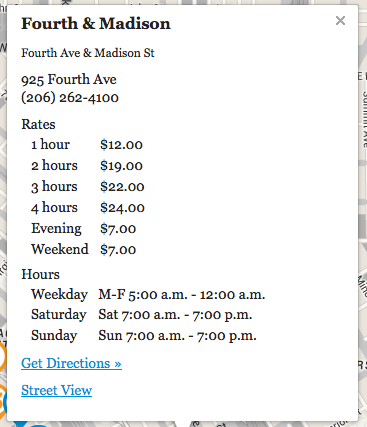
Clear enough, as far as it goes. Doesn't get into daily rates, of course, but it gives you the impression that you know what's up. I haven't found any other published rate information, but I haven't searched very hard: I found rate information, why should I dig further?
Many parking garages, recognizing that they can pack in 4-5 motorcycles in the space of one car, and can put them in places that cars can't fit, offer motorcyclists a discounted rate. This is common, though certainly not universal.
The parking garage in the basement of 4th and Madison used to offer a rate of $7 per day for motorcycles. A few months ago, they changed it, instead charging $31 per day (the same rate as for cars), but offering a discounted monthly rate of $120-some per month. At the same time, they changed their entrances around, allowing the public to enter on both sides, where previously only one entrance was public, the other requiring a monthly pass.
So, as I mentioned, I rode in today. My company offers, as one of its perks, complimentary parking for a handful of days per quarter. Not regular parking by any stretch, but enough for those occasional days when you need to drive in.
I arrived at the newly public gate, and despite my best efforts, couldn't get the bike to register with the inductive loop in the ground, and thus couldn't take a ticket. With a line of cars behind me, I rode around the still-lowered gate arm, deciding I'd deal with it during the day.
I got the ticket squared away, and as part of that, looked up the parking management to ask them if they could increase the sensitivity of the loop to register motorcycles. It turns out they can't for technical reasons that are mostly due to an infrastructural blindness to motorcycles (the trigger loop and the safety loop after it are too close together, so if they're turned up enough to register a bike, they interfere with each other).
However, as part of my discussion with Brian, the parking manager, he said something like this (paraphrasing, of course):
"And, you know, if you get one of the non-monthly parking fee tickets on your vehicle, since you have a validated ticket from your employer, we'll just take care of it at the booth." Further discussion, and he let drop that the value of this extra fee would be $43, although whether that was on top of the normal $31 fee, or in lieu of it wasn't exactly clear. I suspect it was in lieu of it, essentially a $12 surcharge for parking a motorcycle without being on the list of monthly parking pass holders.
So, a daily parker, such as a visitor to the building, would be charged the $31 daily parking fee (regardless of motorcycle or car), and if this motorcycle didn't appear on the list of monthly parking pass holders, it would be charged an additional fee of $12, for a total of $43 for one day of parking.
Now, it would be reasonable to expect that, given such a princely fee, motorcycles would be afforded only the best accomodations. A full car-sized spot, with walls around it perhaps, to ward off inattentive car drivers' doors. Lockers for riding gear and helmets. Possibly some kind of wash or detail service.
Ah-hah. Of course I'm kidding. We can expect to be shuffled off into the odd spots where cars can't be accomodated, directed to areas that look like they're simply off-limits, but bikes park there anyway, because the designated motorcycle spot holds (I kid you not) three bikes. We can expect to be looked down upon as second-class or even third-class citizens (bicyclists get a nicely set up series of racks for locking up, all under the part-time steely gaze of the parking booth attendant). Clearly the motorcyclist is a miscreant.
I understand: I'm not actually responsible for the fee. But if I run out of my company's goodwill validations, I will be, and the injustice to other motorcyclists is unspeakable.
I'm sure, when I go to retrieve my motorcycle this evening, it will be furnished with a $43 parking fee ticket for having the unmitigated gall to not drive a car.
Posted at 11:53 permanent link category: /motorcycle
Wed, 04 Feb 2015
If you're a motorcyclist you probably know about lane-splitting. This is when you ride your bike between slow-moving cars on the freeway or large multi-lane roads, allowing you to go faster than the car traffic.
On the face of it, lane-splitting seems to offer a couple of advantages and a couple of disadvantages. The big pro items are moving faster, and escaping the inattentive rear-end collision. The big cons are that you're playing slalom with a bunch of car drivers who may or may not be paying attention, or actively working against your safety, and that if you're not on your toes, it's easy for collisions to happen.
In my earlier years as a motorcycle rider, I was dead-set against lane-splitting. The reason is that in Washington State, where I live, it's illegal. It's not that I necessarily agree or disagree with the law, but that law provides the backdrop for reality: it's illegal, so no car driver expects it to happen. Therefore, they won't be on the lookout for it, and you can reasonably expect that they'll change lanes without any consideration for a motorcyclist illegally lane-splitting. It's just a bad scene. Then, thinking about it, I couldn't see the real advantages in a place like California where it's legal, or Europe, where it's common practice.
Now, having spent some time in Europe and participated in lane-splitting, I have a more nuanced view of the practice. I like the improvement in speed through slow traffic, and where drivers are expecting it, it seems reasonably safe (although it was still something of a white-knuckle experience the few times I did it in Europe). I still think that doing it in Washington is a terrible idea. It's still a thing that, should Washington legalize lane-splitting, I would be quite leery of until I had some confidence other drivers wouldn't be reacting poorly.
Thus I was interested to read a report from UC Berkeley about lane-splitting accident statistics in California. Turns out that for motorcyclists who are safely lane-splitting (which they describe as riding no more than 10 MPH over the speed of traffic, and through traffic moving no faster than 30 MPH), the rate of injury in collisions is much lower. It doesn't really address the rate of collision, since they didn't collect total traffic vs. collision. What they did collect is stats comparing lane-splitting collisions to non-lane-splitting collisions, and there were far fewer lane-splitting collisions than non-lane-splitting.
The conclusion that can reasonably be derived from the Berkeley study is that prudent lane-splitting is safer. Safer than what, exactly, is hard to define: safer than the other riding activities you might engage in, I guess, but that's a very large category. Importantly, though, it's the inverse of what I had previously thought -- lane-splitting is not your one-way ticket to collision and injury. There's even a Belgian study which found lane-splitting to improve traffic overall. The Belgian study is quite interesting to read about, with some pretty surprising numbers when you change 10% of the car drivers to motorcyclists who lane-split.
So at the end of the day, I find myself with mixed feelings about lane-splitting in Washington. Yes, it would be awesome to be able to do it on those terrible traffic days. But I would spend several years worrying about coming across that small class of car driver who doesn't know, or is convinced that by lane-splitting I'm stealing something from them.
I guess I do ultimately hope it's legalized here. It's far from that point, but that would be a good outcome. But I also hope that the bill legalizing lane-splitting would include a goodly amount of driver education as part of the package.
Posted at 12:04 permanent link category: /motorcycle
Sun, 17 Aug 2014
Savage Beast: Tamed - How to Adjust the Throttle Position Sensor on a 2008 SV650
I followed through with the TPS adjustment procedure on my 2008 Suzuki SV650 today, and it certainly made a difference. This is your guide to doing the same thing.
First off, if you haven't already, go read the full write-up on sv650.org. I am only giving you the addendums to that excellent write-up. Do read through the whole thing.
There are three key and very important changes you need to know about, for any 2007 and onward SV650.
1. The Dealer Mode plug is in a different place.
2. There is no idle speed adjustment.
3. There are two TPS sensors now.
So, the procedure:
- Warm the bike up to normal operating temperature. On my 49-state bike, that seems to be about 170-175 °F. I recommend a short ride.
- Turn off the bike.
- Now comes the first difference: remove the main seat, and you'll find the Dealer Mode plug on the left side, toward the back. You can reach through from the passenger seat opening to grab it if you have a hard time getting both hands in there.
- Insert the Dealer Mode Tool (ie, length of wire) into the pin locations indicated in the sv650.org writeup.
- Turn the key on, and verify that you're in Dealer Mode. The temperature display will switch from its normal indication to -C00 (or something similar). If you see a number other than 00, you have a fault. Check with this list to see what the number means.
- With the motor still off, turn the throttle grip slowly until you see the little line move from the middle position to the top. If you had to move the throttle more than a couple of degrees, you'll be wanting to do the adjustment.
- Lift and prop the tank as described.
- Start the motor and slowly rotate the throttle until you see the line shift from the middle position to the top position. Note the RPM for future bragging rights (mine was at about 3200 RPM). The higher this number, the happier you will be with the change. Kill the motor for this next part, but leave the key on (it's hot enough already). If it switches around 1500 RPM, you're already done.
- Using your trusty T25 security Torx bit, which has been loaded into a shorty socket wrench using a 1/4" socket (don't drop it), unscrew the one and only screw on the rear TPS sensor -- it's only got one screw, and is a little thing compared to the big beastie just forward of it. It's also the only one with a T25 security Torx screw.
- Without touching the throttle grip, move the sensor body up and down until you see the the Dealer Mode display just barely shift to the upper line. It is slow to react. It takes about .2mm of movement. Be patient and gentle.
- Now, move the TPS body in the opposite direction by the thickness of a gnat's wing. Seriously, like .05mm. Almost nothing. The line should just barely drop down to the middle segment.
- This is more or less the right adjustment. Basically, you want the middle segment showing at idle, and the instant you're off idle, it should shift to the upper segment. For fun, start the motor and see where it shifts, but as long as it's in the middle at idle, and shifts to the upper line once you add a tiny bit of throttle, it's right.
- Tighten down the T25 screw, and test to make sure that you're still seeing the middle segment with no throttle, and it jumps to the top as soon as you add throttle (move the throttle very slowly). You may have to adjust and tighten several times to get it right.
That's it. Put everything back where you found it, and go try it out. The difference won't make you scream with delight, but you'll notice that suddenly the bike is a lot less twitchy at small throttle openings -- that is, in traffic, where it's the most annoying thing to have the bike surge forward at the slightest touch of throttle. It's still got that monster power you want, but you have to actually give it some gas to make that happen. Much nicer.
Note that Suzuki kindly included an automatic idle speed system on these bikes, and it may kick the idle up to 2000 RPM while you're adjusting the TPS. This is normal, and it will return to its normal and correct ~1200 RPM idle once you're done. There is no adjustment for idle speed available to us.
If you don't like the change, you now know how to change it back.
This will make your fuel mileage a little bit worse (it's adding more fuel at a smaller throttle opening now), but the difference in a calmer, more sane bike is worth it.
Posted at 20:09 permanent link category: /motorcycle
Sat, 16 Aug 2014
The internet is good for many things, and one of them is finding the solutions to problems. Sometimes, even problems you didn't know you had. Of course, sometimes, those solutions are absolute bunk.
I'm curious to see which of these conditions apply in my case.
In reading various SV650 postings, one of the things I keep coming across is the one about adjusting the Throttle Position Sensor. A TPS is an electronic sensor that tells the engine's computer what angle you've got the throttle set at -- how open it is. But it has a range of adjustment, and if it's adjusted incorrectly, the engine's computer has the wrong idea about where the throttle is set, and so it sends the wrong amount of fuel to the cylinders.
If you believe this posting, most bikes come from the factory with the TPS setting adjusted so the engine runs too lean, particularly at small throttle openings. Well, that's actually pretty important: running too lean means, among other things, that the engine is extremely sensitive to small throttle movements, amplifying any little disturbances (such as might be caused by, say, going over a bump in the road).
Interestingly, this is exactly what's happening with my bike. I refer to it in my initial impressions post as being the "Le Mans experience." It's that over-sensitivity when crawling through traffic that makes the bike a real chore to manage. It always seems to be either surging forward, or aggressively decelerating, with no comfortable middle ground between the two.
So, my hope is that if I can make this TPS adjustment (which will have to wait until I have a bit more time), it will calm the motor's uncomfortable twitchiness at low speed. It may or it may not. For all I know, the bike is already in perfect adjustment. But it's certainly worth investigating.
Maybe I can have the best of both worlds: a comparatively lightweight, powerful bike that is also gentle at low speed. It would be a wonderful thing.
Posted at 09:55 permanent link category: /motorcycle
Thu, 14 Aug 2014

The new SV650 was refusing to start. The internet suggested that maybe the clutch switch connector was the first place to look. (The switch tells the system that the clutch is disengaged, and the starter won't go unless the clutch is disengaged.)
Sure enough: I glanced down at the clutch switch connector tonight, and it was dangling loose from its pins. I jammed it back in place, turned the key, and the bike fired right up.
I do love the easy solutions.
Posted at 21:03 permanent link category: /motorcycle
What is it With Me and Starter Motors and SV650s?
I've been riding the new SV650 the last few days, trying to wrap my head around it. I think I'm succeeding, but last night, ran into a problem: the starter motor wouldn't go after a stop.
I had hoped there would be a number of people with this problem, and that it would have an obvious solution: a similar thing happened to me in Europe, on my 2002. In that case, I was riding along, came to a picturesque spot in Switzerland, and stopped to take a picture. When I went to start the motor again, nothing happened. No click, no buzz, no lame attempt at starting. The switch went in and it was as if it never happened.
I was able to bump-start the bike (endless fun when it's packed with 50 lbs of stuff on the passenger seat), and got going again after about 10 minutes' delay. Once I was going, I decided to do a test, and pulled in the clutch and hit the kill switch. The engine died (as it should), and I tried using the starter to get it going again. Nothing. I let out the clutch and restarted the motor using all that kinetic energy I'd stored up by getting up to road speed. I thus rolled along in consternation, wondering how I was going to finish my trip (with something like 10-12 days left, each day involving at least one start). I tried again, this time paying careful attention to turning on the kill switch before hitting the starter, and to my surprise, it worked.
I tried it a few more times, and it worked every time. I decided that whatever the problem was, it had sorted itself out, and decided that, aside from parking uphill if possible, I'd take the optimistic path, and not worry about it.
Thinking back on this experience last night, I decided to do the same test. Maybe SV650s just lose their starters every once in a while? I finally found a clear enough road, killed the motor, and tried to start it again. Nothing. Again, double-checking the kill-switch: nothing. Crap.
So, I turned around and headed home. I checked the intarwebz for information on the problem, and was greeted by the standard scattershot of questions and answers you see when there's not a known typical problem. Fortunately, I knew all that (check the interlock switches; check the fuses; run a jumper to the starter and relay; etc.), but it means no shortcuts in my troubleshooting. Ah well. The previous owner also says he never saw the problem, so there's no obvious history to provide a clue.
I guess I have some troubleshooting to do.
Update: Some more searching around suggests that it's actually fairly common for the clutch switch connection to have problems, so it may be that there's an obvious and short path to a solution. I'll post my results once I figure the problem out.
The clutch switch acts as an interlock with the neutral switch and the sidestand switch so that the bike can't be started in an unsafe condition, such as in gear while on the sidestand.
Posted at 09:37 permanent link category: /motorcycle
Mon, 11 Aug 2014
I bought myself a 2008 SV650 this weekend, and today I finally had the registration and insurance sorted out, so I took my first ride.
The first impression was, "Oh crap, am I replicating the Le Mans experience?" The Le Mans experience, in this case, means having a bike that's too heavy and powerful for when I end up riding a lot: city streets. There's also an element of abrupt fuel injection response. All these things seemed to be true as I rolled out, but in a way, even more so: the SV650 seems to have considerably more oomph from a stop than the Le Mans ever did. I'm not sure why anyone recommends one of these as a beginner bike. One misapplied throttle twist, and you're shooting across the street before you know what's happening.
It's not really that bad, of course. But compared to the Ninja 250, which has been more or less my only bike for the last 8 years, the SV is kind of a terrifying powerhouse.
I rode around the neighborhood streets for a bit, to get a feel for things. The SV seems well suited to short-shifting, and I was quickly up through the gears even at 30 MPH. Speaking of 30 MPH, I brought my GPS along just to see how inaccurate the fancy digital speedometer actually was. I was amused to see that it read exactly 10% over every time I checked. Even the Ninja 250, a considerably cheaper bike, isn't that far off. In any case, it didn't seem to have any obvious bad habits at low speed, so I aimed for the freeway to see what higher speed was like.
I was denied the fun onramp experience by what was quite possibly the most slowly-driven Prius I've ever come across. I would have been champing at the bit on my 14 HP CL175, to say nothing of this snorting beast I was on tonight. However, in a few minutes we'd traversed the length of the onramp, and I was able to pass the pokey Prius and get up to big-boy-pants speed (ie, the speed of everyone else around me).
The SV650 is much happier going fast.
This comes as no real surprise. It also confirms the first impression of being the Le Mans mark II. The Le Mans was very happy at speed in a way it never was when crawling along. I suppose that's true of most motorcycles. I've really been spoiled with the Ninja 250.
Once on the freeway and going a normal speed, the engine was turning about 5500 RPM at what the GPS claimed was about 65, and the SV's dash display read as 72. The engine still felt eager to go faster, but no longer dangerously so.
I traversed the freeways for a while, and all was fine until I got to some construction. They'd grated up the freeway in preparation for new paving, and the resulting heavy grooves had the bike dancing a little bit. I couldn't say why, but the SV seems much more prone to following the grooves by twisting the frame around than the Ninja does. It wasn't a problem, and I wasn't feeling unsafe, but it was very odd to realize that the Ninja 250 appears to beat the SV650 for torsional stiffness when going over pavement grooves and cracks. I'm sure it's mostly to do with overall weight, and possibly to do with tires.
The exhaust note with the stock exhaust is a satisfying low grumble, very unlike the inline fours or the Ninja 250's high-pitched whine. My SV650 in Europe (a 2002) had a Micron racing exhaust pipe on it, and although it made a very satisfying rumble, it was too loud, and I would have been much happier with the stock can. It sounded exactly right going around the Nürburgring, though.
I noticed that only half an hour into my ride, my butt was already complaining about the seat. I'm going to keep my eyes peeled for a used Corbin or Sargeant seat as a shortcut to getting something a bit more friendly to normal human anatomy. If it comes down to it, I might get a spare seat and carve one up myself, but I feel like time will be a very limiting factor there.
This was definitely the most exciting first ride I've ever had on a motorcycle for one completely unrelated reason: lightning. Seattle's weather has been unusually hot today, and we ended up with a very midwest-like set of thunderstorms grumbling around the area tonight. I've never seen red lightning before (it was internal to the clouds), and I've never been riding a motorcycle when lightning was striking around me. To my amazement, I only got rained on in the very last minute of my ride, just as I was pulling up to my house.
So, I'm still sorting through my first impressions. I own the bike now, so if I decide it's too hulky and powerful, my only choice is to sell it or let it collect dust. One ride is obviously not enough data, so I'll be riding more as opportunities present themselves. I hope I didn't just make a foolishly optimistic purchase.
Posted at 22:28 permanent link category: /motorcycle
Sat, 09 Aug 2014
Almost exactly a year ago, I heaved a pile of stuff into a taxi and set off on what would become an epic, 10,000 km motorcycle ride through 11 different European countries, spanning 6 weeks.
I went by myself, and ended up writing an email home to a small list of people who'd indicated interest in hearing about my adventures. For each email (which ended up being more or less one a day), I wrote for around an hour each evening, and included some of the photos I'd shot that day.
I knew, when I got back, that I'd want to post those emails as a webpage for those who hadn't known about the email list. I converted them all to HTML quickly enough, but the process of distributing the pictures through the text proved oddly daunting, and I kept putting it off and putting it off.
Finally (yesterday), I realized that it was silly to sit on these things for so long. Thus, without further ado, I give you:
Europe 2013: Six Weeks on a Bike
They're not all perfectly formatted, and there are typos and other errors. But they're all very immediate -- written the day those events happened, with everything very fresh and at the forefront of my mind.
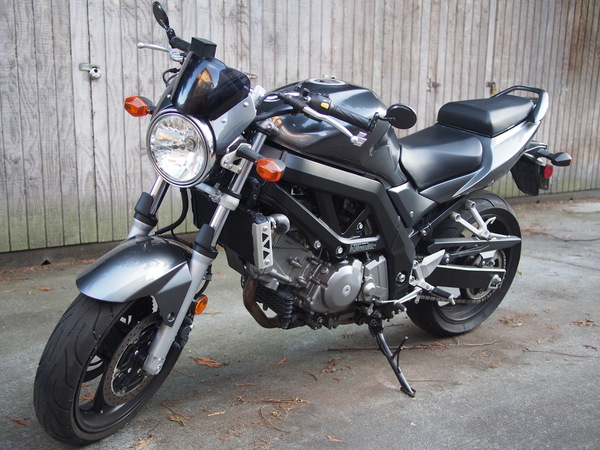
In other Europe-related news, I took the opportunity in Europe to indulge myself in one of my long-held motorcycle fantasies: I bought a Suzuki SV650. It was a 2002, not the 2008 I really wanted, but it was a fine introduction to the bike. I ended up riding it for just shy of 10,000 km, or about 6,000 miles over the course of just under 6 weeks.
I really liked the bike, and encountered no problems other than an intermittent stumble in the rain, which I now know was related to water filling up the forward cylinder's sparkplug well and shorting out that plug. I had investigated the possibility of shipping bikes back and forth, but it was prohibitively expensive, so I couldn't bring my Ninja 250 there, and it didn't make sense to try to bring my Irish SV650 back.
Since then, I've had my eye out for an SV650 here. I had casually looked before, but the experience of riding through Europe was a strong inducement, and my "casual" search became more like "regular." But I never really seemed to find the right thing.
Fast forward (you knew it was coming) to this last Thursday. I loaded up Craigslist, and there at the top of the SV650 list was a grey 2008 affair that looked, at first blush, to be perfect: the unfaired version, with reasonable mileage, basically stock, and for a reasonable price. Intrigued, I contacted the seller, and arranged to look it over.
In person, it was, if anything, even better than the ad had described. There was no corrosion anywhere. The worst problem it had was a dead battery, followed by some dust on some of the frame members and wheels. It didn't look like it had ever been ridden in the rain; it was shockingly clean.
We solved the dead battery (at least temporarily) by jumping the bike from Sam's car. The engine turned over and fired quickly, purring beautifully at idle, and responding crisply to the throttle. Everything seemed to be working, and I ended up making an offer, which he accepted without a counteroffer (but I didn't try to move the price very far).
I tried doing an online payment thing through my bank, which was silly, and would have taken 3 business days to process (of course we were doing this well after the bank closed on a Friday). I set up an elaborate bill of sale to cover the weird condition where the bike was sold, but I couldn't take possession until Wednesday. We both signed, and I went home, deeply wishing that Wednesday would come quickly.
Fortunately, I called the bank today (they have Saturday hours from 9 am to 1 pm), and explained the situation. Sam and I are both part of the same bank, and they were able to do the transfer over the phone instantaneously. I sent Sam a text, and we arranged to meet this afternoon.
Traffic delays aside, all went perfectly smoothly, and a few hours ago I unloaded my brand new (to me) 2008 SV650 into the garage. I picked up a new battery and spare sparkplugs (four total -- I'd forgotten that two plugs per cylinder is awesome, but expensive when tune-up time comes), and spent a few minutes failing to get the new battery installed before I had to run off to attend to theater duties.
The bike is out of registration, so I wouldn't be able to ride it until after I get myself to the licensing office anyway, but it would have been gratifying to have it start up under its own power. Soon.
Still, that's pretty cool. I've been dreaming for something like 8 years of owning an SV650, and it's finally a reality. I'm looking forward to getting it running and licensed, at which point I suspect I'll be finding all kinds of excuses to "need" to take the motorcycle somewhere.
Posted at 20:43 permanent link category: /motorcycle
Wed, 07 May 2014
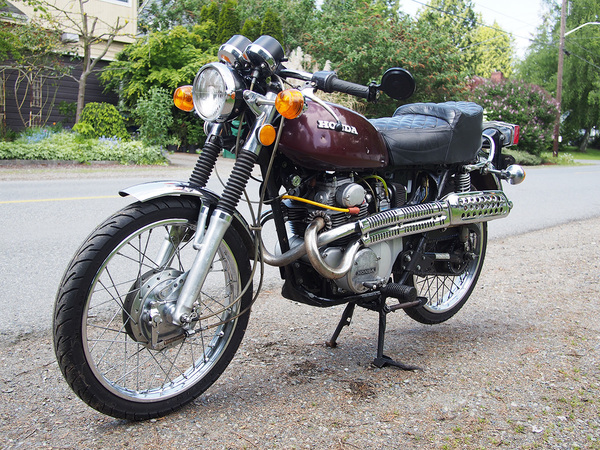
Despite years of ownership and enjoyment, I've decided it's time to part ways with my 1972 Honda CL175. For the tl;dr version:
I've owned this bike since about half way through my brief 3 year racing career -- it was to be my "hot spare," but I ended up liking it enough that I've held onto it even years after I stopped racing. It's ridiculously small, and I'm sure I look like a big yellow gorilla riding a kid's bicycle on it. But for all that, it has (just enough) power to work on the freeway, and a very satisfying grunty motor. It's so lightweight that it feels more like riding a bicycle than a motorcycle, combining the advantages of both.
Of course, it's not perfect. It's 41 years old at this point, and even with its relatively pampered existence, it's still cranky in the morning, and my best efforts have not stemmed the slow seep of motor oil around some of the gaskets. The reworked front brake, while no doubt effective, has a bit of a nonlinear engagement (my biggest worry if I should sell it to a less-experienced rider).
Then again, as I was going through the list of improvements I've made to the bike over the years, it's pretty impressive. There are at least $700 worth of new parts and paid maintenance in the bike, including a Pertronix ignition, Accel coil, new shocks, new chain, top-end rebuild with overbore, reworked front brake, etc. It comes with an impressive array of spare parts, and I even have a pair of engines available as a separate sale. For the right person, this bike is a steal. For everyone else, it's just a reasonable price on a decent, very cool looking vintage motorcycle.
I'm sorry to say goodbye, but I'll be glad to have the space, and this will be a step toward making my own electric motorcycle, which has me unreasonably excited.
Posted at 16:25 permanent link category: /motorcycle
Tue, 15 Apr 2014
I found myself up in Lynnwood last week (weird enough in itself), and realized that it had been years since I'd stopped in to Cycle Barn. There are lots of reasons for this, some good, some just passive, but no matter. I decided I should drop in, and expose myself to a bit of that new-bike smell.
While I was looking over the selection of lightly-used bikes parked out front, my eye was caught by the animated sign -- did that just flash the Zero Motorcycles logo? Curious, I went inside, and checked out the showroom. On the top floor, I spotted them: 2014 Zero S motorcycles just sitting around, like it's no big deal.
A surprisingly non-pushy woman came over and started chatting with me (perhaps the slimy motorcycle salesman is a thing of the past? I can only dare to dream). The magic, glowing words floated through the air, "Would you like to take it for a demo ride?" Why yes. Yes I would.

So I quickly found myself aboard a bright yellow 2014 Zero S. The woman gave me a quick rundown of how things work. The main differences between a normal gas bike and the Zero are the complete lack of controls on the left side (clutch lever and shift lever), and that the "start button" position on the right side is now occupied by a button marked MODE.
The MODE button selects between three different modes: Eco, Sport, and Custom. The Eco mode can be thought of as a governor, preventing you from giving the bike full power. This can make a huge difference to range. The Sport mode unleashes the full power of the controller. Custom can be set up to the owner's preference, but hadn't been set up on the bike I was riding. I don't have any idea how custom Custom can get.
The range thing is interesting. I was very surprised to learn that Zero claims 120 miles range for the bike I was on (with the 11.7 kWh battery) in city, and 80-some miles at freeway speeds. It makes sense, but it's so reversed from the normal gas engine expectation. The electric motor is more efficient at low speeds, and in a city environment you get the benefit of regenerative braking. On the freeway, you're battling wind resistance, which goes up with the square of speed.
In any case, I took a few test-squirts of the throttle in Eco mode, and experimentally switched to Sport. It didn't have a scary launch (the only thing I was worried about -- electric motors can generate up to 100% of their torque at 0 RPM, unlike gas motors; wheelie-town!), so I left it in Sport for the rest of my ride. The launch, in fact, was a bit disappointing compared to the amount of power available when rolling on at speed.
Rolling on throttle at speed was the really exciting part about this motorcycle. There's a common perception of electric vehicles as being underpowered and weak. Fortunately, Tesla has been changing that perception with their ridiculously hot Roadster and now the Model S. You can now add Zero to that list.
From a rolling start at around 30 MPH on the speedometer, I found myself going 75 MPH before I rolled off, and I would guess I was feeling about 1G pulling me back. It was under 2 seconds between 30 and 75. That's excellent performance no matter what you're driving. I'm sure that Zero has set up the acceleration profile in the controller to strictly limit launching torque so people don't accidentally flip the bike on top of themselves. The motor and controller are most likely capable of that, based on the roll-on performance.
Zero claims the bike with the 11.7 battery weighs 399 lbs, which sounds about right. It carries the weight higher up than my Ninja 250, so the bike felt a little ponderous in corners, since it's less than 50 lbs heavier than my little bike. The suspension was a bit soft for my tastes, and I read in a review that the 2014 model had changes to the suspension to increase comfort. The front brake was acceptable, and the rear brake finally provided me with a definition for the term "wooden." It was essentially useless on its own, compared to regenerative braking and the front brake. For perspective, my standard of a good front brake is the stock brake on my 2006 Ninja 250, with the addition of stainless brake lines. The fact that the Zero's front brake is not as good as that suggests that it's not at all good compared to actual performance brakes.
I brought the bike back and thanked the saleswoman. Zero lists the S model starting at $14,995 for the model I rode, which is simply beyond my interest at this point. It's a very cool bike, and one I would be excited to own, but I can't stomach the price.
This leads into part two of this post: musings on building my own electric motorcycle.
It just so happens I have a race-prepped 2005 Ninja 250 doing nothing in my garage, since I stopped racing, and haven't actually hit a track day in years. This has more than once led to the sort of chin-stroking ponder: maybe I should turn it into an electric bike.
My friend Alex has repeatedly pledged his assistance with metal fabrication and build help. We got to talking about it last night, which led me down the rabbit hole of looking at electric vehicle components.
As much for my own future reference as anything else, I'll lay out my thinking here.
The stock Ninja 250 puts out about 28 HP at the rear wheel if you wring it out. Most of the riding I do, in the 6k-9k RPM range, tops out around 20 HP, practically speaking. To cruise on the freeway at 70 MPH looks like it's using on the order of 10-15 HP, based on a very rough estimate from throttle position and a dyno chart. Using these numbers, I started pricing and sizing components.
The choice of battery technology and motor and controller are interrelated, but battery and motor-controller can be separated out.
For the battery, there are essentially two real-world choices: lead-acid, and LiFePO4. Lead-acid has the advantage that it is comparatively dirt-cheap, and the batteries are fairly durable. Unfortunately, its energy capacity per unit weight is also very low, so you end up with a heavy bike that doesn't have much range. Lead-acid batteries also have a limited discharge ability: if you used every amp-hour of a 20Ah battery, it would recharge a couple dozen times before it was dead. You have to leave them partially charged at the lowest point to keep from destroying them. So a 20Ah battery is really only worth 5-10Ah depending on what kind you get.
I calculated out some battery choices using the Zero's smallest battery pack (8 kilowatt-hours) as a standard, and it looks like I would need an improbable number of lead-acid batteries to meet that goal. However, a pack of 22 100Ah CALB LiFePO4 batteries would get me up to about the power density I want in a size that at least looks probable in the napkin-math. The downside to the lithium batteries, of course, is the cost. Where I could get up to a 72v system with lead-acid batteries for $1300 (with a very limited range of 10-15 miles), the lithium batteries will cost around $3500.
(Napkin math on battery space: the Ninja 250 has a roughly 9" x 18"
x 18" space where batteries could go, for 2916 cubic inches. 22 100Ah
lithium batteries are 2794 in
The major advantage of lithium batteries is energy density. That 22 pack of batteries holds just over 7 kWh of energy, which is enough to do over 70 miles of city driving using a conservative 100 Wh/mile. If they are discharged to zero? No big deal, charge 'em up again, they're fine. No deep-discharge problems with lithium batteries. They add up to 155 lbs, so the batteries alone will outweigh the 90 lb Ninja 250 motor.
So, if I can stomach the cost, I've got my battery question sorted.
Next up is the motor and controller.
For cost reasons, mostly, I restricted myself to DC motors. They're cheaper, they're pretty efficient, and they're relatively lightweight. The internets are scornful of brushed DC motors for EV applications beyond low-powered scooters and the like, since apparently they have a relatively high failure rate. So I kept my search to brushless designs.
It quickly became apparent that Motenergy is the one and only choice in commodity EV motors. So my search narrowed down to the point where I was really only considering two motors.
The first is the Motenergy ME1012, which looks like the ideal thing. It's rated up to 72v (my target voltage), and is typically described as being a 10 kW motor (about 13 HP) for continuous use. That lines up nicely with my estimation of cruising down the freeway on the Ninja 250 above. It's capable of a peak output of 24 kW or 32 HP, which is better than the 250's peak power when burning dinosaurs.
It's about 8" in diameter, and looks (again, napkin-math style) like it would fit on the 250 frame.
The close runner-up is the Motenergy ME1115, which is exactly the same thing, except it's newer, uses fancier position sensing tech, and can handle up to 96v (a factor which doesn't matter to me). It's also more expensive, but both motors are still $1000 or under, making them less than half the price of an equivalent AC motor. Both motors are 35 lbs, so that the "wet weight" of a loaded-up Ninja 250 (about 360 lbs) will be a bit of a distant dream -- the electric bike with 100Ah batteries would probably weigh over 400 lbs. It may be worth reconsidering the battery size, based on the weight issue.
All the reading I've done so far suggests that the correct controller to match these motors is the Sevcon Gen4 controller, in the Size 4, 72v variation. It's a spendy controller compared to a brushed motor setup (motor and controller cost a bit less than twice as much as a roughly equivalent brushed-motor setup), but the Sevcon controller is leaps and bounds ahead of the brushed equivalents in terms of tech. It is, practically, a new design, while most of the other controllers out there are using a decades-old design. Notably for me, it speaks CANbus, which means I can easily interface to it using microcontrollers, in case I want to do any fancy display programming of my own...
I totted up the bare prices of this controller ($925)/motor ($520)/battery ($3146) combo (without shipping or anything else) and came up with $4591. Obviously shipping will add a few hundred dollars, but that's the major components covered.
Of course, that is far from the whole story. Off the top of my head, I can think of the following items that aren't included:
- Battery charger: up to $1000
- DC-DC converter: up to $300
- Wire and connectors: about $500
- Contactor: about $200
- Pot-box and accessories: another $500
- Steel and building materials: $300
So, in the worst case, that's roughly another $3000 on top of the $5000 for major components. The bike itself cost me $1100, so is amusingly one of the cheaper parts of an electric bike build, particularly considering that I got value out of it already as a track bike. It's definitely not a cheap build. It could be done for less. I'm not committed to doing this right now. But having done the major research to get me started (I'm sure there's another month of research necessary should I go through with all this), it looks more probable.
I'll have to think about the weight issue more. I only started doing research on that as I was writing this post. The advantages of going to a smaller/lighter battery are pretty noticeable: cheaper, less volume (so the bike doesn't have to look so slab-sided), and somewhat ironically, better range-per-watt-hour, since the motor doesn't have to accelerate the weight of the bigger batteries. The Ninja 250 is intended as a small, light bike, and I'd like to preserve that in the electric incarnation, if possible.
I've been thinking about doing something like this for a long time. Most of my riding is 10 miles to Capitol Hill and back. On my longest errand day, I go maybe 60 miles. Most of my trips are doable by bicycle, although on long days or days where I need to go multiple places, this becomes impractical. Having an electric motorcycle would eliminate 95% of my carbon emissions (since electric power in Seattle mostly comes from hydroelectric dams, and is carbon neutral). If I wanted to blow another $10k on solar panels -- and this is the real dream -- I could charge my electric bike without using any grid power at all. And, really, how cool would that be?
Posted at 14:05 permanent link category: /motorcycle
Sun, 27 Oct 2013
The Next Big Thing (or Not, as the Case May Be)
Ever since I got back from Europe, I've had this image in my head of riding around on an SV650. It's such a different experienece from riding the Ninja 250. Even with my little things I didn't like, I find myself drawn to it.
So, I was trolling around Craigslist, like you do, and came across an ad for a 2007 SV650 with 11,000 miles for $2900. That's quite a good price, so I decided to follow up on it. I just came back from seeing the bike.
I should always remember that people aren't dummies when they price things, most of the time. I figured there had to be a reason it was priced so low (most bikes of this type and vintage are going for more like $4000), but I had forgotten the myriad of things that can be wrong with a bike.
The description just says it runs great, and has 11k miles. That's true, as far as it goes. It neglects, however, to mention that the bike has been stored outside without a cover for its entire life; that it's been down; once on each side; with broken levers and things to match; that the rear brake simply doesn't work (apparently the master cylinder is busted, which is not a thing I've heard of happening without some kind of provocation); that the stock exhaust was long ago discarded in favor of a loud "stubby" can; that the ignition key basically needs to be wrestled with to actually turn the switch; that the rear turn signals have been replaced with little pods that face the wrong way; and so on.
I wasn't expecting perfection when I got there, but I was surprised by how inaccurate the description was, without being wrong about any of the facts it did contain.
It was interesting to see my reactions to all this, too. I am truly a finicky person, and this made me realize just how particular I am. The thought of riding someone else's wreck is simply not one I'm willing to consider, even for a fairly noticeable discount in price. I knew with only a moment's reflection that having to wrestle with the key every time I got on the bike would drive me insane. It's a problem I could fix, but it would be amazingly vexing until I did. It's actually fairly amazing I didn't get a bike like this when I went to Europe, and this reminds me that I did get a pretty decent deal there.
So, overall, an interesting experience, and one that gives me some food for thought. I had been thinking I might want to get an SV650 next, but given that they are now only available used, I may have to change that plan. They seem to appeal to the essential "infrequent riding dude" demographic, which is the exact opposite of me, and it's very unlikely I'm going to be pleased with most of the bikes on the used market.
So maybe a barely-used black Ninja 300 will come to my attention...
Posted at 15:36 permanent link category: /motorcycle
Tue, 15 Oct 2013
Things I Don't Miss About the SV650
When I got back from my epic 6-week trip around Europe on a 2002 SV650, one of the first things I did was to get back on my little Ninja 250.
Of course, I was coming from 10,000 km on a massively torquey V-twin with three times the power of the Littlest Ninja, so my first thought was to wonder if the engine had something wrong with it. The Ninja 250 cannot be ridden in the same way as the SV650, no doubt.
What I didn't expect, though, was some of the negative reactions I had to the SV650 as I started riding my little Ninja again.
The first thing I noticed was the ignition lock. On the SV650, at least the one I had, if you didn't line up the key into the lock pretty carefully, it would jam out of alignment, requiring some force to break free. I recognized it as being annoying on the SV, but I didn't realize just how different it was until I started up the Ninja 250: the key slid right in, and even trying to start it out of alignment, utterly refused to jam. It was ridiculously pleasant.
To my absolute surprise, I found the transmission on the Ninja 250 to be way nicer. Not just the neutral finder (at least in daily riding -- if you want to bump-start the bike, the neutral finder makes it more or less impossible), but the whole thing. Shifting was smoother, and the transmission on the Ninja 250 was just generally much more pleasant to use. Shifts on the SV650 were notchy to the point of being annoying, and every shift required the patented BMW technique: lift up for the upshift, and hold the pressure until after the clutch lever is released. Otherwise, it'd be a false neutral every third shift. The SV costs thousands of dollars more than the Ninja; I was shocked at how bad the more expensive bike's transmission was.
This is more specific to my modified Ninja 250, but the suspension was another surprising difference. I have replaced the springs in my forks, putting in much higher-rate springs. I have comletely replaced the rear shock with a Hagon after-market unit (with a slightly too-strong spring). The suspension on the Ninja 250 felt much more taut and controlled than on the SV650. This also comes down to not loading 50 lbs of crap on the passenger seat, but I was still surprised. The Ninja felt like a race bike compared to the soft cruiser-ish suspension of the SV.
Not surprising at all was the weight of the Ninja 250. The dry weight is only 50 lbs different (304 vs. 360-some, as I recall), but the larger engine on the SV takes more oil, and the weights are set up differently, so the center of gravity is also doubtless in a different spot. The Ninja 250 felt like a toy bike compared to the gravitas of the SV650. I feel a similar difference when I go from riding the Ninja 250 a lot to getting on a bicycle.
Of course, in the end, it will take many months of riding the Ninja 250 before I forget the extremely gratifying power of the SV650 engine. That is the one and only glaring difference most of the time: now, when I grab a handful of throttle, I am acutely aware of the limited performance of the Ninja 250. I still like the bike, but I won't soon forget the simple, thoughtless ability to go faster right now, pretty much no matter my initial speed. The only time I noticed any lack in the SV650 was riding the Nürburgring, being passed by supercars and liter bikes. I can't even imagine what the Ninja 250 would have felt like there.
I still like my Littlest Ninja. I'm not likely to trade it in for an SV650 any time soon. But suddenly the Ninja 300 sounds a lot more appealing with its more torque, more horsepower and better gas mileage. May have to start saving my pennies.
Posted at 00:06 permanent link category: /motorcycle
Fri, 20 Sep 2013
So, it's been radio silence here for a while, but big things are coming: I just took a 6 week trip through Europe on a 2002 SV650 (which was awesome), and took a ton of pictures, as well as writing an update every day. All that will be appearing here soon.
The bike, which worked ridiculously well, is now for sale:
2002 SV650 w/ Micron race exhaust
I realize that my readership here is probably not too excited about having to fly to Ireland to pick up a bike, but you never know.
Posted at 08:12 permanent link category: /motorcycle
Wed, 08 May 2013
I've been feeling like my Ninja 250 has been a bit weak in the knees lately -- maybe the last 500 miles or so. Nothing bad, just a little bit clattery, a little bit of wheezing where I wasn't sure it used to. Finally the time came this weekend for a major service.
In this case, that means adjusting the valves, replacing all the various fluids, repacking the steering head bearings, and a bunch of ancillary maintenance that I might as well do while I've got it all apart. I started on Sunday, and even though I started in the morning and kept going until 11 pm (with a chunk of time off in the evening to deal with theater business), I didn't get it all done. When I left off on Sunday night, the bike was still in pieces, and I knew I was waiting on at least one major component: the front brake line had been rubbing against the horn for years, and finally wore through the plastic outer sheath. It's probably still safe, but I'm going to replace it anyway, and I'll change the front brake fluid then.
The order of the services was plotted out, and I realized that I needed to change the oil and filter, and check the carburetor synchronization, as the last thing. Those are both services which require the engine to be up to operating temperature.
So, it was my task this evening (finally having time free to work on it) to go for a little ride. It wasn't long, just a mile up, then on to the freeway, down to the next exit, and back home.
But... oh my! What a difference a valve adjust and new sparkplugs make! Where before the bike had felt a bit wheezy and out of breath, suddenly it felt surgingly alive. The 6000-9000 RPM range, which is where I was intellectually aware "the bike comes alive," now suddenly lives up to that description. It actively leapt forward upon getting some throttle at 7500 RPM. Thrilling! For the first time in a while, I actually wanted to ride just for the sake of riding.
It's always amazing to me when this kind of thing happens. You don't notice the slow, gradual decline, until the thing is renewed, and then it's this amazing shock! of recognition: Oh yeah, that used to be awesome! Well, it is again.
It's Bike to Work Month, so I'm not spending any time aboard the motorcycle at the moment, but I'm suddenly quite looking forward to the next outing.
Posted at 22:28 permanent link category: /motorcycle
Thu, 14 Feb 2013
Ninja 300 First Ride Impressions

I took the opportunity to test ride a Ninja 300 this week, and was struck by the experience. I have seen a lot of pro reviews (which are generally favorable), but very little from the Ninja 250 perspective, and figured I'd share my thoughts.
If you're coming across this article and know nothing about me, I've been riding a Ninja 250 since 2003, and have owned bikes ranging in size from a 1972 Honda CL175 (175cc) to a 2001 Moto Guzzi Le Mans (1100cc), including a number of BMW Airheads, a K bike, and a Goldwing sidecar rig. I've been riding since 1999, and I'd say that (with one short break) a Ninja 250 has been my primary bike since about 2004. I also had a 3-year stint racing F160 (CL/CB 160s and 175s) until I realized I wasn't having any fun.
I should start out by saying that my ride was only 15 minutes, since that was the policy of the dealership. I ended up spending 13 of those minutes on city streets, and a minute or two on the freeway, travelling from the entrance to the next exit. Still, it was an instructive experience.
I will refer repeatedly to the 250 in this review. I am specifically referring to the 1988-2007 era Ninja 250, before the 2008 makeover.
The Approach

This covers much of the same ground I wrote about before, but in less detail.
The Ninja 300's styling is obviously up to date with the current Kawasaki line of sportbikes, but I was interested to note the extent to which it shares Ninja 250 DNA under the fairings. Notably the frame and engine layout are obviously directly descended. Many of the more-visible bits, like the wheels, swingarm, exhaust, brakes, etc. are newly designed. The overall impression, though, is one of a brand new bike.
I was given a Special Edition green model to ride, which was functionally identical to the black and white models they had sitting nearby: it was news to me to learn that you could get the SE green model without ABS. SE green sets you back $200, and ABS sets you back another $500, but you can't get ABS on the other colors, so if you want ABS, you have to spend $700 over the base price.
I was pleased to see that the under-seat storage is actually a bit expanded from what was available on the 250. It's all under the passenger seat, but there's a fold-up tray suitable for small items like cellphones, and a larger area underneath which carries the tool kit, and has space for something else of a similar size.
I asked the parts guy, as part of our conversation about the bike, what he thought of the IRC tires the bike comes equipped with. He said he thought they were actually pretty good, had been getting good reviews, etc. We were both surprised by that: IRC has been a bargain-basement brand in my experience, but apparently with the appearance of the new-gen Ninja 250, the Honda CBR250R, and now the Ninja 300, small-bike 17" tires are proliferating, and the quality is improving. Good news for everyone.
On the Bike
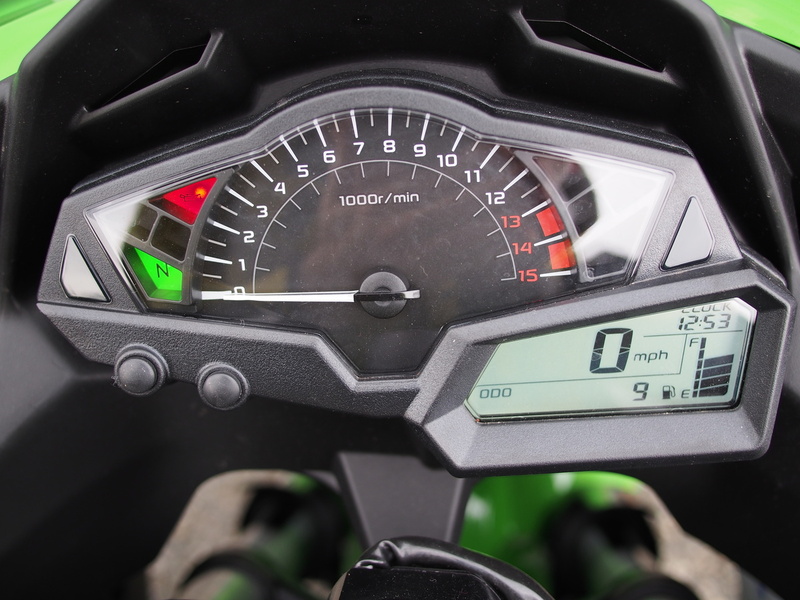
The first thing I noticed about the bike while sitting on it was the instrument cluster. I had found the new-gen 250 instruments to be disappointing, but the 300 finally has a vaguely modern-feeling LCD and gauge cluster. I thought the startup sequence was actually fairly pretty, and was pleased to see the Kawasaki engineers having more fun with it. I was disappointed to see that, although they've given us a passing switch, Kawasaki still hasn't seen fit to give us hazard lights. There's even a cutout where the switch goes. Quit cheaping-out on safety features, guys.
The next thing I noticed was that the seating position is essentially identical to that on my 250. The handlebars and pegs are in the same positions relative to the seat. The main difference (which I really became aware of later) is that the tank is much wider. The whole bike, in fact, feels wider, because it is. The 250 has a very slender front profile befitting its narrow engine, while the 300 takes on the wide appearance of the 600 and larger machines. I understand the choice, but I don't really agree with it -- this bike has a narrow engine, and there's a lot of empty space being encompassed by those fairings. It feels a bit silly, like the bike is pretending to be something it's not.
The seat is a pleasant shape, not so sloped as the new 250's seat. I didn't feel like a quick stop would result in infertility, unlike on the 2008+ 250. It's also covered in a pleasantly grippy vinyl, which made it feel like I could pick a seating position and not worry about sliding around at all, yet wasn't so adhesive that I wouldn't be able to reposition. This was borne out once I was riding.
Get Up and Go
Starting the 300 is a surprising experience compared to the 250. I barely touched the starter, and it was purring. I'm sure this is thanks to the fuel injection system, which is a new development for the 300 (and an omission that caused a lot of grumbling on the 2008 250 refresh -- pretty much everywhere except the US got FI on their new 250s, but the US got carburetors). On my 250, I have to pull the choke on unless the bike has been warmed up, and then I spend the next five minutes slowly lowering it, and starting takes a number of crank revolutions. On the 300, it seemed like it revolved once, and was running.
As I started out, the odometer had all of 4 miles on it, so I was comparatively ginger with the bike. I was immediately impressed by the clutch, which was light and easy to engage, and not snatchy at all. From the diagrams I'd seen, I figured it might have a last-moment "lock-up" feeling, but I didn't notice it if it did. This was due to a misunderstanding of how the clutch's slipper function worked.

I also immediately noticed that I was riding in the 3000-6000 RPM range almost exclusively. Although you can do this on a 250, it's not a recipe for impressive performance; the 250 doesn't come alive until after 6000 RPM, whereas the 300 was clearly very happy from 2000 up, with plenty of power. The power curve must be much fatter in this range.
The bike made a pronounced high-pitched whine, which was probably coming from the cam chain. It overpowered the relatively subdued exhaust note, and made me feel like I was piloting a spaceship. As RPMs increased, the exhaust got louder, but in around-town riding, all I could hear was the whine. I didn't find it annoying, it was just different. I was wearing earplugs for the ride, so it's possible the whine would be overpowering without them.
The tank width became much more obvious to me once I was rolling, and I noticed that scooting all the way forward into the tank, I was making contact with it all the way along my legs. It was a reassuring contact, which sounds a bit odd to say, but was my impression at the time. The footpegs are the all-metal type now preferred, and I was interested to note that they have a distinct lip on the end, making it immediately obvious through my boots what my foot position was. The foot and hand controls quickly faded into the background, which means they worked as expected.
I found that in practice, I don't much like the layout of the tachometer. I'm used to having about 60% sweep around a circle, and I found the 40% sweep to feel oddly limiting. It was a little bit like driving a 60s Chevrolet, with one of those super wide "linear" speedometers. I'd love to see Kawasaki go back to a larger sweep, more circular tach with an LCD display in the lower corner for speed and such.
I was surprised to find that the LCD includes an ECO indicator (confusingly being a triangle of hexagons, which took me several glances to comprehend). I assume it shows when you're not blazing through gas, but I guess that's not really something I need help with, so I disregarded it once I figured out what it was.
Engines and Transmissions
The engine feels very different, yet very similar, to my familiar 250. The key difference is the addition of power in the 3000-6000 RPM range, which became apparent the instant I started riding. In character, the engines are very similar between the two bikes, which makes sense. They're the same layout, very nearly the same engine.
As a result of the fatter midrange power, the bike felt paradoxically weaker at the top of the RPM range (which I only touched briefly, while getting on the freeway). Although it has 7 more HP at th rear wheel than the 250, the build up to full power is less impressive. It's linear, whereas the 250 has an increasing slope (or so it seems when comparing the two), so that the 250 just seems to keep getting more powerful. The 300 doesn't get that extra punch impression, even though it's a considerably more powerful bike.
The transmission was another feature of the bike that faded into the background. I didn't notice any problems or anything noteworthy about it, which is a solid win in my book. I did notice that the "neutral finder" (blessing of beginners, and bane of bump-starters) feature is still present.
Riding Impressions
The mirrors are too narrow (as usual), so that the only way to see directly behind you is to lean way off to one side. The mirrors showed a perfect reflection of my hands, or the spot in the lane next to me, though. If I get a 300, it will immediately receive bar-end mirrors.
The suspension was pleasantly set up, sporty feeling, but not harsh. I didn't get a chance to really test it, but it's a very nice change compared to how the 250 was originally set up, with super lightweight springs. The tires were also pleasant to ride on, with a very neutral turning feel, and what appeared to be good grip (but again, with only 4 miles on the clock, I wasn't interested in testing how much of the release compound had already been scrubbed off).
The brakes felt fine, although the front brake didn't bite very much. I suspect that will be improved as they wear in. As promised, the stock line didn't particularly feel spongy. I didn't have an ABS model, and wouldn't have had a chance to test it if I did. I noticed on the German site that ABS was only mentioned on the front wheel, and not the rear. It's not clear to me whether or not the ABS system covers the rear wheel (although it probably does).
I didn't really notice the speedometer while riding, other than briefly on the freeway. My impression was that the speed display was a bit on the small side, but that's probably less of a problem once you're accustomed to look for it there. I am pleased to see two trip odometers. I hope the fuel gauge is actually worth anything, but I'm not holding my breath.
Back on Terra Firma
Once I finished up my ride, I took a bunch of photos, and shot a brief video of the gauge cluster's startup sequence. I was disappointed to note that the taillight is a single incandescent bulb, which seems like a mediocre choice in this era of LED taillights. LEDs don't burn out. That alone recommends them highly. If I get a 300, it wlll also immediately receive some add-on LED taillights.
I was pleased to see that the passenger seat (which is easily removed using the ignition key) is designed in such a way that it would be feasible to design replacement plates that could go there. I am specifically thinking of building a cargo plate, which would facilitate my beloved "shrimp basket," which I use practically every time I ride. However, I was also pleased to see that there's a complete set of hooks under the seat: the forward set is small, and just under the edge of the passenger seat; the aft set is larger, and down near the license plate holder. Unfortunately, this positioning means that any straps attached down there will have to rub on the bodywork, making them considerably less appealing.
What Would I Change?
The list of things I'd change on the bike is surprisingly short. I would add one or two power plugs (the little BMW type). I would add bar-end mirrors and LED taillights. I would make up a cargo plate to replace the passenger seat. I might install additional position lights facing forward, to make it even more obvious it's a motorcycle, since the turn signals don't contain running lights. I would look into whether the left switch pod could be replaced with one containing a 4-way flasher switch. On the 250, it's a simple swap, and gives you 4-way flashers (although the turn signal indicator doesn't light up when using them).

Overall, it's a surprisingly well set up bike. The price still gives me pause, but it's easy to see the appeal of the various improvements. It's not hard to imagine that I would pick a 300 as my next bike. My main question is whether I really need a new bike right now. Generally, the answer is no, and there's some appeal to waiting for next year's model. This would give Kawasaki time to sort out any bugs in the design, and might possibly give them time to come to their senses, and offer ABS on all colors, instead of just the Special Edition Horrid Kawasaki Green model.
Posted at 00:30 permanent link category: /motorcycle
Sat, 02 Feb 2013
Kawasaki introduced the Ninja 300 late last year, and they're now in dealerships. As soon as I read the spec, I was intrigued: a more-poweful version of the bike I like so much, with fuel injection, 17-inch wheels, and the possibility of ABS. My interest was further piqued when I read the numerous reviews, which seemed to be pretty positive. One of the things that catches my attention from the reviews: reviewers were able to achieve shockingly high gas mileage (in the 60s and 70s on average, with trips up past 100 by riding carefully), which is my holy grail, and one of the primary reasons I like my 250 so much.
Of course, the new Ninja 300 is $4800 list, and $5500 if you want the Special Edition, which is the only way to get ABS. When I bought my 2006 Ninja 250, it was two years before the end of that model (it was dramatically restyled and redesigned for the 2008 model year), and it had a list price of $3000. I think I got the bike out the door for $3500, plus another ~$500 or so in parts, getting it set up with new suspension bits and brake lines (which are absolutely required for the old-style 250 to be a real motorcycle).
The new Ninja 300 is, however, also a largely rebuilt bike. It still has clear Ninja 250 ancestry, but lots of the pieces have been dramatically upgraded, and it's now styled in the modern Kawasaki style vs. looking like something that was designed in the 80s (because it was designed in the 80s). I quite like how my 250 looks, but it is also quite dated-looking. The new 300 includes fuel injection (a huge upgrade), and 17" wheels (allowing a huge range of tires to be fitted, vs. the 2 or 3 types that are available for the 16" Ninja 250). If you spring for the SE version, it includes ABS, something I've been wanting for years.
I don't care even slightly about the styling, but the technical upgrades (and I haven't mentioned the increased power and torque, which apparently make a huge difference) are pretty compelling. I don't know that they're $5000+ compelling, but I decided today that I should investigate further.
I stopped by my local Kawasaki dealership, and spent about half an hour looking over a triumvirate of Ninja 300s: a Special Edition ugly-green model, a black, and a white. They're identical, except for color, and the fact that the SE model has ABS. It was a good chance to check out the things I was curious about, but the reviews hadn't really touched on.
The seat, for instance, unlocks and lifts, but only the passenger section, which is completely separate from the driver's seat. Under the seat is a small flip-up tray, suitable for small items like a cell phone or tiny packable jacket. Under that is a larger area, which houses the tool kit, with a surprisingly large (like, tire patching kit large, not helmet large) space which is unoccupied. The design of the passenger seat makes it clear to me that I could manufacture a cargo plate to replace it fairly easily, which is good: I'd been worried about how I would carry stuff if I replaced my trusty 250.
The dashboard includes a welcome set of information: tachometer is front and center, with a digital speedometer (which can be switched back and forth between MPH and km/h), fuel gauge, clock (thank you!), two trip meters and odometer. It doesn't include a coolant gauge -- although I've never needed it, I've always been interested to keep track of my coolant temperature, and I'm a bit sad to see it gone. The salesdude said that the backlight on the digital section (which is quite bright) can't be dimmed, which is unfortunate for night riding, when I fear it will be a distractingly bright light in peripheral vision. It may be low enough to be out of my sight line, though.
The 300 has two headlights (again, thank you!), and "city lights" (little marker bulbs that come on regardless of whether the headlight is on or not). Unfortunately, only the right headlight is illuminated on low beam. Fortunately, high beam adds the left light, rather than turning off the right light and lighting up the left. This should be a good addition to the visibility of the bike. Unfortunately, they still have a single incandescent bulb for the tail/brake light, so among my first changes would be to add LED tail lights.
The 300, happily, has human-sized suspension components. That is to say, the springs are set up for a real rider, instead of the impossibly light rider the engineers apparently envisioned for the original 250. Sitting on the 300 doesn't feel like sitting on a toy bike. The parts manager I was talking to pointed out that the new rubber brake lines are much stiffer than the old style, and that I wouldn't need to replace the line first thing (that was on my "required" list for the old style 250, along with new suspension springs).
The 300 doesn't include a centerstand (although I'm sure Kawasaki will sell you a kit for $300 or something), but that's not the end of the world. The oil filter, although a welcome external filter instead of the old internal filter, is positioned so it perfectly drains all over the exhaust pipe. I don't really understand that choice -- it creates a fire hazard, which you'd think Kawasaki's lawyers would be keen to avoid. The mechanic I talked to for about 15 minutes suggested that the 300 was far easier to set up than the old 250s were, which is encouraging news for someone who's intending to do all his own maintenance. I was a bit disappointed to see that, although Kawasaki has equipped the bike with a high-beam flasher, it still doesn't include a four-way flasher (which, on my 250, is a simple matter of swapping out a switch pod). I hope the upgrade remains as simple.
It was satisfying to see the bike in person, and sit on it. I was pleased to discover that the 300 doesn't have the new 250's distressingly "slide you forward" seat design, which would make quick stops potentially quite painful. I deeply wish the ABS were available in any color instead of only Kawasaki's trademark "arrest me" neon green. Company pride is fine, but don't force me to participate in it. Although I have very limited ego invested in what my motorcycle looks like, it does extend as far as not having bright green as the primary color.
I'll be headed back when there's a bit more time in the day (I went close to closing time), and take a test ride. I'm very curious to see what my impressions are, although I will most likely regret doing it, and be much more excited about parting with my hard-earned cash. It looks like a fine upgrade, and one I'm interested in for my own sake, as well as one I want to signal to Kawasaki is a good direction.
Posted at 19:39 permanent link category: /motorcycle
Sun, 06 Jan 2013
I haven't really been riding the motorcycle too much lately. It comes in very handy when I have late nights at the theater, but apart from this very utilitarian duty, it mostly sits as I ride my bicycle for my daily transportational tasks.
Even so, I still manage to rack up the miles, and the old Bridgestone BT45 tires I've been running forever were finally bad enough that I had to replace them. Feeling in a daring mood, I decided to look into the other options available in good tires for a Ninja 250. That more or less boils down to the Pirelli Sport Demons. There are other tires that will fit, but they're either good tires that require modifications to the bike (mostly raising the front fender) or cheap tires that I don't trust very well.
So, I decided to take the plunge, and get the Sport Demons. The one thing I knew, that rang in my memory like a bell, is that they don't cup as they wear. This is what happens when adjoining blocks of tread wear unevenly, resulting in a series of diagonal blocks, instead of a continuous surface. The practical upshot is that the bike starts to feel very uncertain when going around corners. It's not, and the grip is fine, but the feedback from the tire is unsettling, at best. The BT45s will forever live in infamy in my mind, for they do this typically with about half the tread left. So I get half the life out of those tires that I theoretically could, which irritates my frugal soul to no end.
As I had suspected would be the case, I ordered the tires, and they arrived, and it took almost two months before I had the right confluence of time and energy to tackle the re-shoe job. It's not terribly difficult, but it does take a few hours, and it's also not simple. Changing motorcycle tires is something I started doing years ago, and I still like doing it, in a sort of abstract, "I'm more independent this way!" sort of way. I finally got them levered onto the rims in early December.
When riding on brand new tires, one must be gentle. Tires come out of the mold with a release compound, which you may safely think of as being grease. It's not actually, but it's more lubricant than anything else, and that's great for getting them out of their mold. Not so great, though, for actually riding on. So the first 50-100 miles are ridden gingerly, as if your tires are coated with lubricant.
Within seconds of starting out on my new tires, I noticed a huge difference from the BT45s: the Sport Demons are a very triangular profile! I guess this is common knowledge, but I hadn't been conscious of it before. They tracked very nicely in a straight line, with a slight tendency to wobble. But in doing some very shallow swoops as I rode along, they clearly wanted to lean into the corner, and stay there. It was disconcerting.
Apparently also common knowledge is that the BT45s are a very round profile, so they have very neutral handling. I was not best impressed. I don't want the bike to suggest anything. If I'm going into a turn, I want to tell the bike that's happening. It shouldn't urge me along -- that's what the cupped tires do, sort of, and it's what I was hoping to get away from. The Sport Demons are much more controlled about their urging than the cupped BT45s, and there's no feeling of being out of control, like there is with the cupped tires. But still, it's a bit unsettling.
There's another choice, of course. On my race Ninja 250, I had fitted Pirelli MT75 tires, which are unique in being the smaller 120/80-16 profile rear tire and 100/80-16 front. The BT45s and Sport Demons are 130/90-16, which theoretically slightly pinches the tire into a more-triangular shape than they're strictly designed for, due to the slightly narrow rear wheel. With the MT75s, there's no pinching, thus the shape is truer to what Pirelli intends. There's also about a 2 pound weight savings per tire, which is pretty significant.
The MT75s, however, did not favorably impress me as rain tires. On one of my few outings aboard the race Ninja, I had a damp track, and noticed a very distinct sense of losing grip, more than the BT45s had. They're probably fine for normal riding, but that little niggling sense of losing traction was enough to turn me off them. I don't want to have tires I can outride, although granted, I was outriding them in far more strenuous conditions than I ever allow myself into on the street.
So, for the moment, I'll live with the Sport Demons, and see if I can get used to the bike falling into corners a bit more than I want. If not, I may swap over the MT75s, and see if they treat me a bit better. I already know they have a lovely profile, it's just a matter of wet grip. And if I love the MT75s, a new set costs less than $150, vs. the nearly $220 of the Sport Demons. There's that frugal soul again...
Posted at 21:04 permanent link category: /motorcycle
Sun, 25 Sep 2011
Way back in the beginning of time, when I was riding BMWs around, unaware of my low-powered future, I thought to myself, "Hey, those Ninja 250s. They look cool. I should try one at some point." It took me years to finally act upon that thought, and years more to realize how valid it was: I bought a used 2001 model, rode it for a few years, then sold it thinking I had a better idea in mind. It took less than a year to realize what a mistake that was (my short-lived Kawasaki Z750s), and I sold it to buy a new 2006 Ninja 250.
Since that time, I've been pretty happy with the Ninja.
Some time in the 2003-2005 era, I also thought to myself, "Hey, those SV650s. They look cool. I should try one of those at some point." I actually test-rode one at a local Suzuki dealership, and came away with a grin that would take days to fade, and the firm conviction that here was a bike that was sure to land me in far too many speeding tickets. I handed it back with mixed emotions, but never really pursued it further. Until now, of course.
Later-model SV650s offer something that I would dearly love to have (although I've never actually needed it): ABS. (You can read about my adventures in ABS at Aurora Suzuki here.) Despite the racer-boi contention that ABS is for weaklings who don't know how to ride, I like it, and think it's immensely applicable to the real world, where I ride.
So, I've had my eye out for an ABS-equipped SV650 for a while. They're hard to find, as it wasn't a popular option with the racer-boi crowd who are the cultish fan-base of the SV650. I did, however, finally find one for sale near Seattle, and determined to go out and look at it.
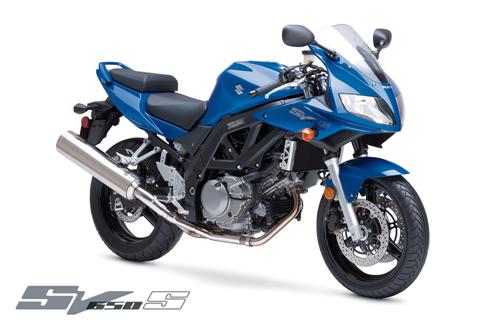
2007 SV650S
It was an S model, which is less desirable to me, as it has a more leaned-over riding position, although the little fairing is fine, and I really like that both headlights are on with low and high beam. Most of the ABS models sold were S models, so if you see an SV650 with ABS, it's probably an S. I'd prefer the non-S model, but finding one with ABS is essentially impossible.
I agreed to meet the owner at a local business, and spent a few minutes appreciatively looking over the bike, and chatting with the guy. He was very nice, and didn't seem to be one of the aforementioned racer-bois (as was demonstrated by his ownership of an ABS model bike, really). His bike was in good shape, and didn't look like it'd been abused.
Then came the critical moment: "Do you have any interest in trading bikes with me and going for a short ride?" I asked. He demurred, suggesting that as my interest in the bike was not burning-hot, he'd rather not take the risk. I agreed with him, and although it lasted a few more minutes, that was the end of the meeting.
The critical trick about this whole business for me is that motorcycles are not penis-extenders for me. They have to be enjoyable (which is a term that's probably unrecognizeable to a majority of bikers, the way I define it), and they have to be efficient.
One of the things that attracted me to the Ninja 250s in the first place was the nearly ridiculous mileage claims: up to 70 MPG! Doesn't apply to me, of course, as I'm apparently high-mileage kryptonite: I weigh too much, and ride in the city. This combination is deadly, and meant with all my bikes that the internet would claim "55 MPG!" and I'd get 40. So when the internet claimed "70 MPG!" for the Ninja, I took it with a huge grain of salt, and ended up getting 48 MPG average until I changed the gearing and upped my average to about 51 MPG. Good enough, and I now get the occasional tank over 60 MPG.
So, the mileage on the SV650 was critical. What convinced me to look further into it was reading Motorcycle Consumer News's review of the 2007 model in a multi-bike review. They said they got 58 MPG in their ride testing, and they can't have been gentle on the throttle in their testing. I was intrigued. The seller of this particular bike listed that he got 55 MPG. When we actually talked, he said that was achieved by commuting on the bike, with the "occasional burst" of heavy-handed throttle usage.
I had also dived into a few SV650 forums and looked for mileage threads. They weren't hard to find, and the general consensus was that the later models such as the one I was looking at get in the mid-40s in real-world use. I tend to reserve my light-footed driving for the truck, and prefer to use a motorcycle more aggressively, so I knew I would be seeing in the 40s. This effectively disqualified the SV650, and for the day or so before I went out to see the bike being sold, I was uncomfortable with the idea of spending money on such a bike.
One of the things about the Ninja 250 I have now is that I really really like it. Without writing a novella on the subject, I'll just say that it has the right balance of light weight, enough power, and good gas mileage to keep me smiling while riding. That includes long trips, canyon carving (to the extent that there are canyons to carve around here), commuting, whatever. It's the right bike for me.
And I knew that if I spent a bunch of cash on a new SV650, I would want to ride it. And I would. And it might mean the end of my Ninja 250 ownership (for it might make more sense to keep the more-powerful but similarly-efficient bigger bike). And that, I must say, was a disquieting thought.
Pretty much the only thing that would convince me that I would be happy on an SV650 would be to ride one. The only way I could wrap my head around it would be to climb aboard, pilot it around, feel the rush of the more-than-doubled power to weight ratio, and realize that I could have all this and reasonable gas mileage if I were to ride carefully. I could give up the careful compromise of the Ninja 250. But only if the new compromise gave me something wonderful in exchange for the lowered mileage and increased law-enforcement involvement.
So when the seller declined my request to ride his bike, it was with a sense of relief that I wrapped things up, climbed back aboard my beloved Littlest Ninja, and headed back to Seattle. Confident, as I was, that the Ninja 250 really is the best bike for me. Because where's the temptation from a bike I know is going to get worse mileage, and may or may not offer a more enjoyable riding experience (see above: "enjoyable" doesn't mean "most powerful," because apparently I'm not like everyone else).
Posted at 15:59 permanent link category: /motorcycle
Categories: all aviation Building a Biplane bicycle gadgets misc motorcycle theater